The scale model RC airplane: How to find the balance point (C.G.)
The scale model RC airplane has to be balanced but where is the position?
There are many schools of thought regarding where to balance a scale model RC airplane. I do not wish to get into any arguments with aerodynamicists,( who know far more than I do) but I would like to pass on the information that I have used to successfully find that elusive and so important point!
 My own design Fairey Fantome, balanced using info from this page
The above photo does prove that the methods listed here do work and are fairly simple to use.
If you would like more info on the Fantome or even purchase a set of plans visit this page.
Mean Aerodynamic Chord (MAC) for monoplane scale model RC airplanes
One theory is that all flying airplane models should balance at a point defined as 25% of the Mean Aerodynamic Chord, with no consideration given to tail area or moment arm. For the scale model RC airplane, I prefer to take these facts into consideration.
When designing a scale model we do not have the ability to change dimensions or ratios-we are restricted by our wish to build an accurate reproduction of the full size.
The formula I have used, came from a book written a few years ago by Gordon Whitehead titled "Radio Control Scale Aircraft Models for Everyday Flying" ( A great book that every scale modeler should own)
Here is the formula- CG POSITION = MAC/6+(3 X TAIL AREA X TAIL MOMENT ARM ) / 8 X WING AREA. Note that the Moment Arm is defined as the distance from the 25% MAC of the wing to the 25% MAC of the tailplane.
For a constant chord wing the MAC is obvious but for tapered or swept wings it is not so easy. However a simple graphical method is shown here-
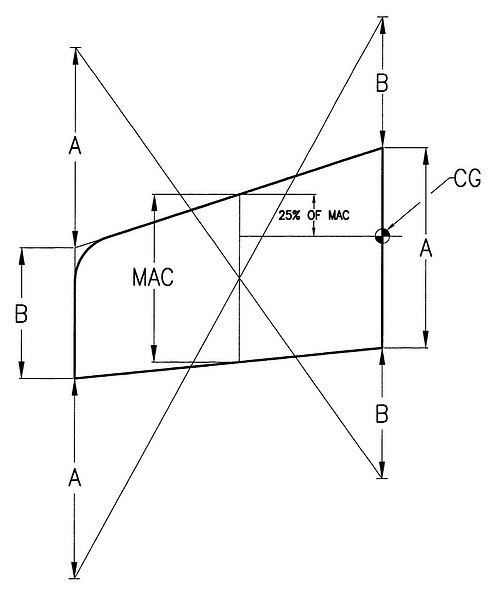
Draw or trace the wing shape as shown. Then extend the Leading Edge ( L.E.) and Trailing edges to the center line of the plane. Also square off the tips. Now extend the opposite chord lengths as indicated on the drawing; i.e. lengthen tip chord B by root chord A and A by length B. The four extreme points are then connected by diagonals. The point where these lines intersect will indicate the Mean Aerodynamic Chord (MAC). To find the 25% of MAC position we must measure 25% of the MAC back from the L.E. and extend this to the aircraft center line.
A useful calculator can be seen here, that may save you some time and/or confirm your calculations.
Mean Aerodynamic Chord (MAC) for Biplanes
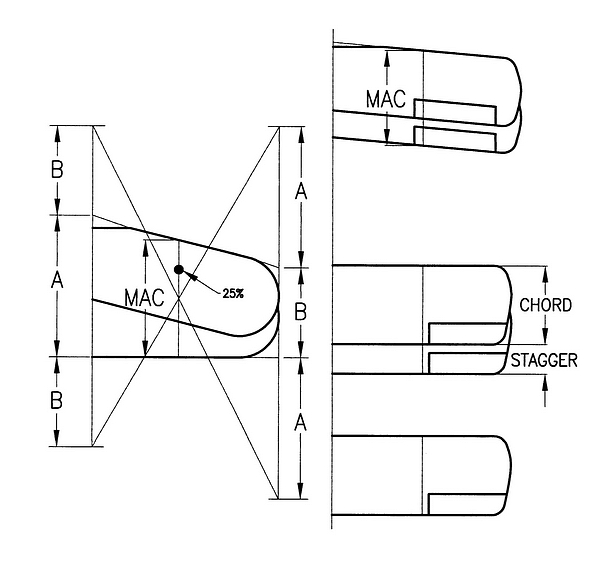
The drawing shows various biplane plan view layouts.
In the case of straight wings then the MAC= CHORD of UPPER WING + STAGGER.
The example on the left is the most complex and shows the procedure for types with a swept upper wing and straight lower, such as "The Little Toot"
Calculation Example- The Fairey Fantome Biplane
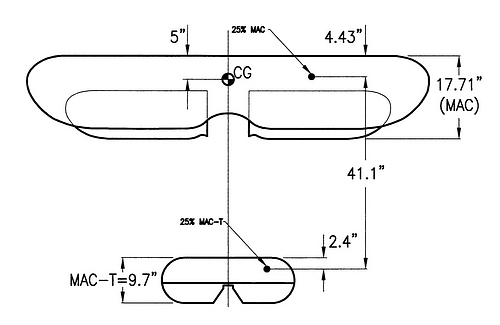
Note that the top wing area=1220.8 square inches, bottom wing area= 583.1 square inches, giving a total wing area of 1803.9 sq.inches. The tailplane area=239 sq. inches. The Moment Arm was found to be 41.1 inches.
Substituting these numbers in the formula-
CG POSITION = MAC/6+(3 X TAIL AREA X TAIL MOMENT ARM ) / 8 X WING AREA.
=17.71/6+(3 X 239 X 41.1) / 8 X 1803.9
= 2.95+ 29468.7 /14431.2
= 2.95+ 2.04
=4.99 inches. Say 5 inches.
Elliptical Wings-Spitfire Etc
For the scale model RC airplane with an elliptical wing, such as the Spitfire, we divide the wing area by the wing span. The result is the average chord. If you now move your ruler along the wing plan, until you find this dimension, this will give you the position of the MAC ( or at least close enough for our purposes )
Do a similar exercise for the tailplane and you will now be able to find the moment arm. Now you should have all the information to plug in to the formula.
Tailless Designs and Deltas
If the scale model RC airplane you are designing is a delta or of a tailless configuration then the formula reduces to -
CG POSITION= MAC/6
Therefore locate the MAC, on the wing plan and measure back from the leading edge 1/6 of this distance. This point is the CG or balance point.

If you are still having problems locating that elusive balance point on your scale model RC airplane, then please contact me via the "Contact Us " page.

Get Gloster Gladiator Profile eBook Free

Don't worry your e-mail address is totally secure.



Beginner's
Guide To Flying RC Airplanes is the essential eBook for anyone
looking at getting in to flying RC airplanes. Step-by-step guidance on all you
need to know about getting in to this fun and exhilarating hobby. Written by
Peter Carpenter.

Beginner's
Guide To Flying RC Helicopters is the heli-equivalent to the above
ebook - the ultimate 'getting started' heli guide!
Click here to view more details
Recent Articles


-
The Bristol Bulldog vintage biplane, of the RAF, in 1930
May 22, 23 10:47 AM
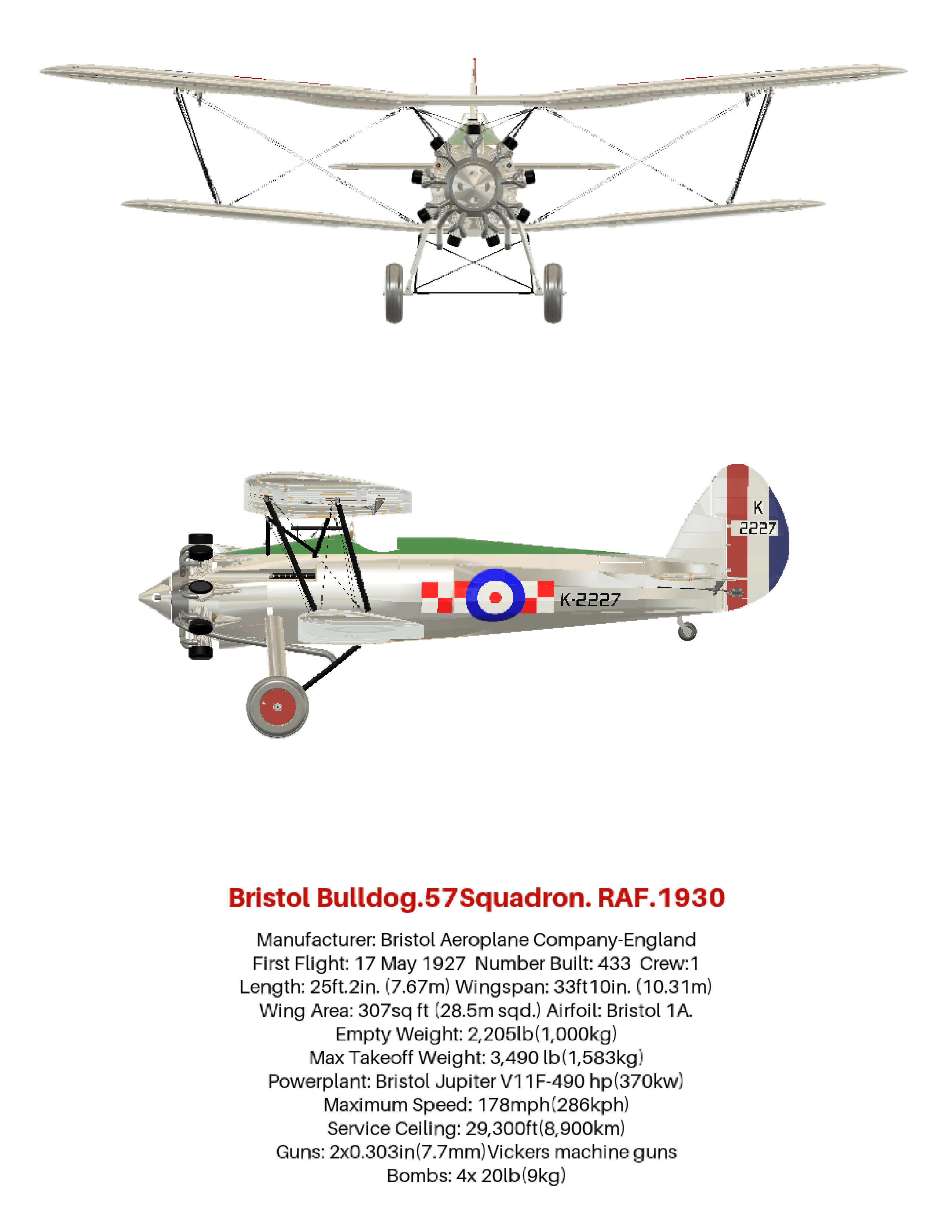 How the aviation art, of the Bristol Bulldog vintage biplane, was produced, using 3D software. Included are photos and links to many aviation gifts, from Zazzle
 -
Aviation gifts For All Airplane Lovers
Apr 20, 23 11:12 AM
 Aviation gifts for every occasion. Give your airplane fanatic friends and relatives the present they will really appreciate! Can be customized to make it truly unique.
 -
RC Retractable Landing Gear: The JP Hobby ER-005 Metal Strut Set.
Dec 19, 22 01:55 PM
 Full details of RC retractable landing gear. For models up to 6 Kg (13.2 lbs). Steerable nose wheel and sequencer for gear doors and brakes. For grass strips.
 -
FLEX RV-8 70CC FLS:ARF and ARFSV.
Nov 02, 22 02:45 PM
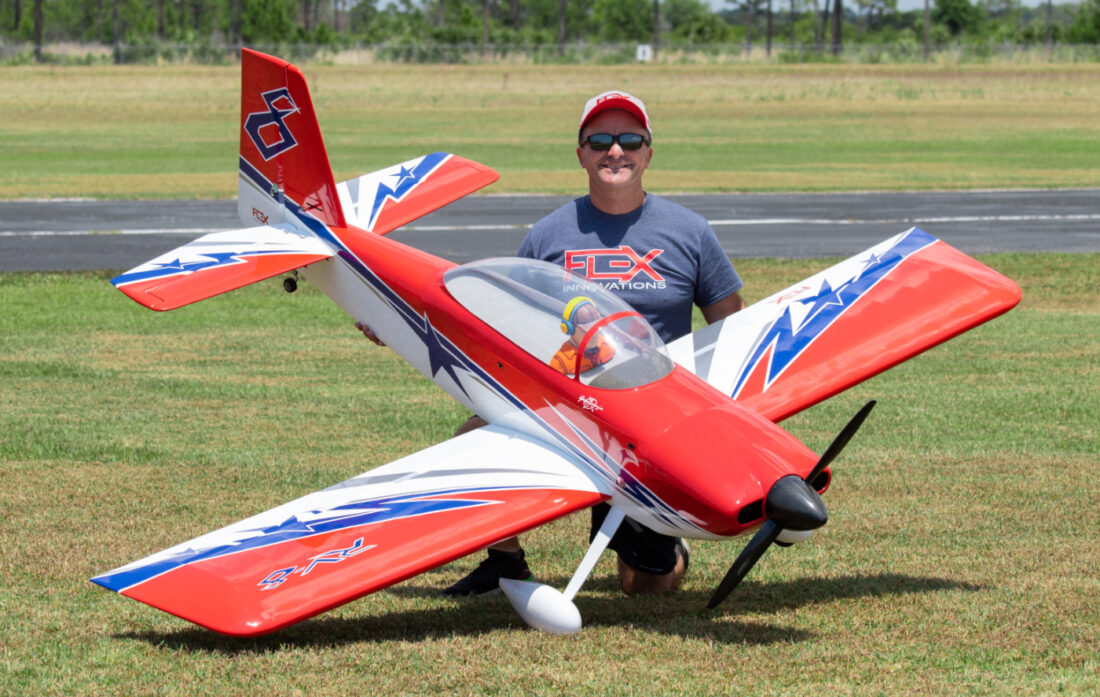 The Flex RV-8 70cc, 35% Scale, 3D RC Airplane. Super lightweight and gas or electric power. Very complete and fast assembly.
New! Comments
Have your say about what you just read! Leave me a comment in the box below.